The Newbie Tax - Krysia - Substack
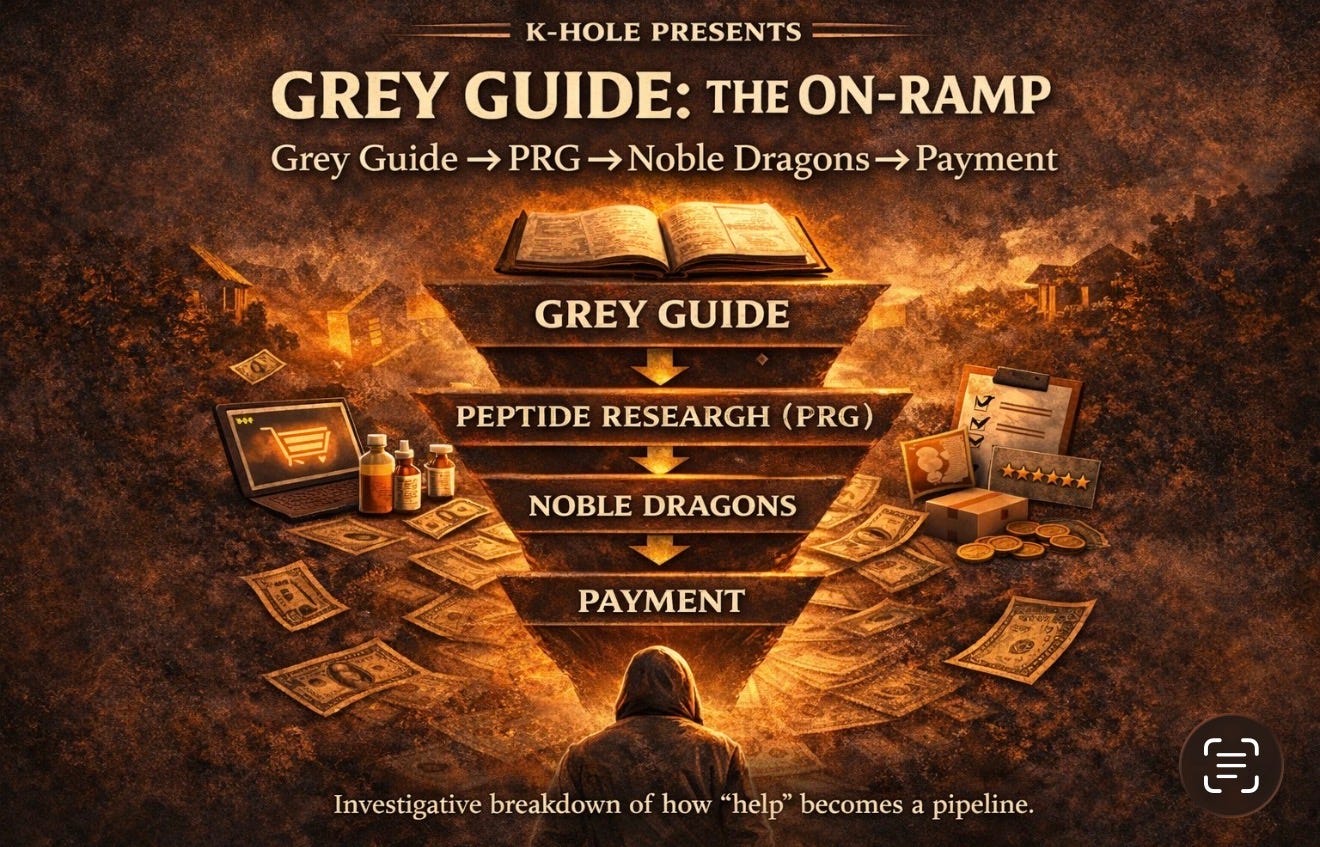
The scenario is simple: A newbie decides to “go grey” after getting priced out, and while researching how to do it safely, they stumble onto this site: https://www.gray.guide/ It sounds like harm reduction. It reads like a handbook But if you follow the path i
The scenario is simple:
A newbie decides to “go grey” after getting priced out, and while researching how to do it safely, they stumble onto this site:
https://www.gray.guide/
It sounds like harm reduction.
It reads like a handbook
But if you follow the path it lays out, it behaves like a funnel.
“Give up or get creative.”
“When Ozempic and Mounjaro started costing over $1,000 a month, people like me had only two options: give up or get creative. This guide is for everyone who chose the second option.”
That’s how the Grey Guide introduces itself.
It frames itself as a community resource built by someone who claims to have endured the same four figure pharmacy quotes, insurance denials, supply shortages, and sticker shock.
The language is familiar and effective:
“Practical, step-by-step information.”
“Universal Safety Principles.”
“We don’t give medical advice.”
“No commissions. Ever.”
“Treat Grey.Guide as a flashlight, not a prescription pad.”
It feels like community protection
It sounds like transparency.
But the guide doesn’t just inform.
It routes
And if you follow the clicks you begin to see a very specific pipeline:
Education → Community → “Verified Vendors” → Telegram → Payment
This isn’t an accusation.
It’s a road map.
And for newcomers entering the grey market for the first time, that map may carry a cost.
Some in the community call it the Newbie Tax.
Step 1: Authenticity (with constant exits)
To be clear: there is plenty on Grey Guide that is genuinely useful for beginners.
It offers:
a breakdown of options (how to go grey)
a controlled pathway
content that gives the impression of authenticity
But at almost every opportunity, it inserts links outward
a link to “Verified Vendors”
a link to a Telegram group ( PRG)
a link to their Reddit thread: r/glpinsiders
The site shows it’s updated by a “Mr Fox” (the welcome page shows an update date of June 18, 2025).
So the question isn’t “is any of this useful?”
The question is: where does the usefulness lead?
Step 2: Vendor Concentration (choice that doesn’t feel like choice)
When you open the Verified Vendors directory, one thing jumps out immediately:
Out of the hundreds and hundreds of vendors in the wider grey market, the shortlist here is tiny and only one vendor (Alex Wu / Noble Dragons) appears to have substantial review volume and a “good seller” style label. The others look newly added and have no review history.
Among the three listed vendors:
Two have no reviews
One; Alex Wu / Noble Dragons carries:
dozens of positive Telegram testimonials, all five star, the oldest reviews dating back as far as August (as shown on the directory)
“good seller” moderator verification
payment convenience (PayPal / credit card), while the other two are described as crypto only
If this directory has been operating since mid 2025 and only one vendor shows depth of feedback, the outcome is predictable
For a newcomer:
This doesn’t feel like a choice.
It feels like a safe default.
Most newbies will not choose a vendor with crypto only payment options.
Step 3: The Community On Ramp (PRG)
For “immediate answers,” Grey Guide links to a Telegram group called Peptide Research Group (PRG).
PRG shows:
around 5,710 members
an owner listed as Pink Feather
Pink Feather’s Telegram status shown as “last seen within a month” unusual for an owner of an active community
Inside PRG, the “Verified Sellers” topic contains; again, the same three vendors.
A timeline clue
Inside PRG, the vendor timeline raises a structural question.
The group has been running since September 24.
Two of the “verified vendors” were posted on November 24
(…yet there were pinned messages in that channel before then)
And the third vendor was added later on January 7 2026
So: how exactly were these vendors “verified”?
I asked Molly from Jeep if she knew anything about this and her response was;
“I dont know but my customer said this group is recommended us 😬”
“Before a person contact us said many customers recommended us to him so he post our info,I am not sure he is a owner or admin”
But when I contacted BDB, he was not pleased and had no idea who the group is, his response was;
“Can we stop them?”
“We just don’t want anyone to be cheated”
Jeep and BDB are a rather random choice of vendor, but they confirmed with me they only take crypto as payment, so not the best choice for newbies, who will most likely end up with Noble for this reason alone.
Step 4: The People Being Routed
It doesn’t take long to find the newcomers this pipeline is designed for.
One person asks whether everyone is in the USA, and answers their own situation like this:
“I am. Had a prescription and got fucked by insurance, so here I am.”
“Not sure what the etiquette is here, but I’ve never gone through a group like this. How do I get started with actually ordering/where do I go?”
That is the funnel’s ideal customer: motivated, anxious, under pressure, and asking for a path.
Another message shows a parent trying to navigate this for a child:
“15yrs old, we’ve already went to a provider and it was prescribed to her. Payments ballooned to $300 a month… I’m trying to do the utmost due diligence I possibly can.”
This is who the “flashlight” rhetoric is built for.
Step 5: The Review Loop (real satisfaction + newbie vulnerability)
The Seller Reviews channel looks legitimate. People seem genuinely happy with service.
One example included:
“This is my first order and at all points my expectations were exceeded… the website is designed… I was able to easily track the package from my iPhone… arrived 3 days faster than anticipated… Alex is very responsive… thanks again.”
Newbies repeatedly praise the same things:
easy ordering through a clean website
convenient payment methods like PayPal
quick shipping
responsive support
reassurance and hand holding
But newbies are also the easiest audience to satisfy with what looks official;
a COA icon
a lab name
“verified” labels
a tracking portal
polished UI
That doesn’t make their satisfaction fake.
It just means their satisfaction may not be based on the things that actually matter long term (batch traceability, COA correspondence, upstream source stability).
Step 6: Controlled Discussion (containment)
Inside PRG:
“Verified sellers only.”
Discussion of unapproved vendors = removal.
Vendor critique framed as negativity
Threads questioning COAs or sourcing transparency often redirected or closed.
Mods who push too hard reportedly removed.
So the educational grey.guide site points to:
→ a vendor directory
→ that points to a Telegram group
→ that limits vendor discussion
→ that reinforces the same vendor
This is containment.
Step 7: Conversion Psychology (why this works)
Look at the recurring language in Seller Reviews:
“New to this grey world so needed something easy to get started.”
“Clean website and credit card option.”
“Answered a few questions I had for being a newbie.”
“Good source for first timers.”
That phrase appears again and again:
Good for first timers.
Why?
Because the real value proposition isn’t purity.
It isn’t price.
It isn’t even lab verification.
It’s technical barrier removal.
Crypto is intimidating.
Customs is intimidating.
COA interpretation is intimidating.
So the funnel offers:
PayPal
credit cards
“US shipping” language
clean UI
moderated reassurance
And for that barrier removal, the markup can be significant.
That markup is the Newbie Tax.
The “Mr Fox = Alex?” suspicion (as reported by former members)
As PRG tightened its “verified sellers only” policy, a narrative began circulating: that the person running PRG (“Mr Fox”) might be the same person as the dominant verified vendor in the ecosystem (Alex / Noble Dragons).
A former PRG moderator told me many members began speculating due to:
Response patterns: similar responsiveness windows and communication habits
Accountability gaps: enforcement against “negativity,” slower public pressure on the dominant vendor when COA questions arose
Vendor concentration: the dominant vendor remaining central/only vendor with momentum
Origin story claims: described as “well known sources” without transparent sourcing detail
They also said people who pushed hard on these questions were labeled “negative” or “harmful,” and removed from the group.
Whether or not the identity speculation is true, the conditions that create it are clear:
when a group restricts vendor discussion, concentrates social proof around one seller, and treats criticism as community harm, members begin questioning whether verification is independent or internal.
That’s the governance problem at the heart of the Newbie Tax.
The Warehouse Question
On the surface, Noble Dragon presents himself as having:
US warehouse
Canada presence
Australia warehouse (in integration)
China shipping
The Telegram group uses flags and “Ships from US warehouse” language. Support messages reference AU warehouse stock. Telegram discussions mention US domestic shipping.
For a newcomer, this matters.
“Domestic warehouse” equals:
lower customs risk
faster shipping
psychological legitimacy
reduced seizure anxiety
But group comments complicate the picture:
some orders reportedly shipped from China despite expectations of domestic origin
multiple upstream sourcing points are described
different batches appear to circulate under one storefront
warehouse language may refer to fulfillment partners rather than owned inventory
None of this automatically indicates fraud
The issue isn’t whether third-party fulfillment exists
The issue is disclosure clarity.
If a customer believes:
“This is coming from your US warehouse”
But operationally the model is:
Payment → broker → upstream supplier → regional shipper
Then the risk profile changes ( see my previous post “ Who actually ships your peptides?”) especially in peptide markets where:
batch traceability matters
COA correspondence matters
storage conditions matter
When sourcing is opaque, batch consistency becomes harder to audit independently.
Inside Noble Dragons TG chaos (Growth Narrative)
In an emotional post in the support channel on Feb 16, Alex explains:
processing 100+ orders per day
working 10+ hour days including weekends
growth exceeding expectations
automation investments underway
not “just in it for money”
personal story about Tirzepatide changing his life
It reframes:
operational strain → growth success
delays → scale
backlogs → demand
And strengthens the narrative of legitimacy.
High Volume, High Activity Environment
The group seems quite active;
New buyers asking basic questions about dosing, reconstitution, storage
First-time customers celebrating smooth deliveries
Repeat buyers posting positive follow-ups
Frequent “please create a support ticket” responses
Ongoing warehouse updates and shipping clarifications
The tone feels busy, growing, and community driven.
It creates momentum.
Customer Service as Public Theatre
Inside the group, a pattern emerges.
Shipping delays are met with: “Please create a support ticket.”
Wrong tracking numbers: “DM me your order number.”
Warehouse confusion: “Stock is limited, integration in progress.”
Payment processor disruption: “PayPal placed a hold; use crypto temporarily.”
Each response is reasonable on its own.
But the flow is consistent:
Public concern → redirected to private ticket → moved to DM → resolved quietly (or not).
The surface remains calm. The disputes are handled offstage.
The issues raised publicly include:
Split shipments across multiple order numbers
Incorrect tracking numbers (in some cases belonging to other customers)
Delayed responses to tickets and emails
Confusion around warehouse origin (US vs AU vs China stock)
Temporary removal of credit/debit processing due to payment gateway holds
Beyond logistics, product concerns have also surfaced:
Incorrect items shipped (wrong strength or product code)
Label mismatches (RT10 vs RT15, cap color inconsistencies)
Visible particulate matter in vials
At least one reported sterility failure
COA alignment questions (covered separately)
None of these incidents alone prove systemic misconduct.
What stands out is how they are handled.
Concerns are rarely resolved in the open.
They are routed inward, individualised, and absorbed.
The public channel stays positive.
The complications move behind the curtain.
And for a newcomer scrolling the group, what remains visible is:
5-star praise
Fast shipping posts
Responsive owner statements
“First order arrived!” testimonials
What disappears is the pattern of conflict management.
That’s control of the narrative layer.
And in a funnel ecosystem, narrative control is everything.
But resolution almost always shifts into private tickets.
Warehouse Language
Inside the group, “warehouse” is used constantly:
US warehouse
AU warehouse
China warehouse
Integration delays
Limited domestic stock
Different shipment origins
It sounds structured.
It sounds global.
It sounds controlled.
But the language shifts depending on stock, timing, and circumstance.
Orders described as “US warehouse” may still involve upstream China sourcing.
AU warehouse is framed as “in integration.”
Domestic stock is “limited” when needed.
China remains the fallback.
Warehouse becomes a reassurance term, not a fixed location.
For a newcomer, “US warehouse” signals safety:
faster shipping
lower customs risk
greater legitimacy
But if warehouse simply means “where the parcel was dispatched from this time,” not “where inventory is controlled and isolated,” then the perception of stability exceeds the reality of custody.
The issue isn’t that multiple warehouses exist.
It’s that warehouse language implies control.
And control is exactly what buyers assume they’re paying for.
The COA mess
If logistics explains how the system operates
COAs determine whether that system can actually be verified
This is where the structural tension becomes visible
Missing Batch Numbers
“Almost all of the older COAs have a batch number listed on the test results. The one provided for the R15 I received has nothing… I feel like I have been misled.”
Date Inconsistencies
“How is the COA date before the manufacture date of the goods I received?”
Reply included:
it’s from the same batch
manufacturing date is when it’s packaged
“I know this doesn’t make sense”
“The only way to confirm would be to test it.”
Eight-Month-Old COAs
“The COA is 8 months old. What’s the likelihood it’s the same batch?”
That question alone captures the issue.
An eight-month old COA will not reflect the batch currently being shipped. Production cycles simply don’t operate on that timeline.
“We Tested in Our Lab”
“No we do not have COA for these. They have been tested in our lab. If you are planning on buying, I recommend you get it tested first.”
This shifts verification back to the buyer.
Internal testing may exist ( though still unlikely)
But internal testing without independently verifiable linkage does not replace third-party traceability.
The Core Issue
The problem isn’t whether COAs exist.
It’s whether the buyer can independently confirm that the COA corresponds to the exact batch in hand, without:
submitting a private support ticket,
relying on internal database confirmation,
or paying for additional testing.
When:
batch numbers are missing,
dates do not align,
older COAs are reused,
visual markers (like cap colour) are used as identifiers,
and discrepancies are resolved privately,
verification becomes relationship based rather than document based.
This is not necessarily about falsified reports.
It is about traceability.
And in injectable products, traceability is the difference between reassurance and confirmation.
The Website Layer
Noble Dragons offers:
credit/debit cards, Apple Pay, PayPal, and crypto
real-time tracking portals
a review system with “verified purchase” badges
COA icons referencing Janoshik testing
batch codes displayed at checkout
“Ships from China Warehouse I / II” or domestic warehouse tags
a VIP program for customers who post reviews
For international orders, the site states a flat $49 shipping fee, but inside Telegram Alex confirms ~$15 shipping for USA.
On paper, it feels structured, transparent, and professional
And that’s the point.
Barrier Reduction
The site removes nearly every barrier a newcomer typically faces;
no need to navigate Telegram price lists
no need to negotiate via DMs
no need to use crypto if you don’t want to
no need to understand supplier chains
no need to source direct from China
The ordering process feels familiar like any other e-commerce checkout
Barrier reduction builds confidence.
What the website centralises
The storefront becomes the anchor of trust:
“COA included”
“third-party lab tested”
five-star reviews
tracking dashboard
FAQ explanations for batch variation
warehouse labels
Everything is contained within one ecosystem
You aren’t interacting with an upstream reseller; you’re interacting with a brand layer
That brand layer may source from multiple upstream suppliers, but the interface consolidates it into a single identity.
COAs FAQ section
COA icon = Janoshik-tested (arranged by “fulfilment partners,” results posted on-site)
No COA icon = manufacturer-tested in-house (buyer encouraged to test themselves)
Purity guarantee: if Janoshik confirms <97% purity, they claim they’ll refund and reimburse “reasonable” third-party testing, whether or not a COA was published (this is a much lower purity guarantee than elsewhere)
built-in flexibility
cap colours can vary
COA from a different batch may be attached to shipping email
minor batch code variations treated as normal
The request process
To get a COA, you have to provide your email, you then receive a random, much older COA (several months old)
the COA is watermarked with your email across it, discouraging sharing and making community cross checking harder
The Price Comparison: Where the Newbie Tax becomes visible
Once you understand the funnel, the next question is:
What are you actually paying for?
For consistency
Noble USA shipping: $15 (confirmed in Telegram)
China-direct shipping: $50 (flat estimate for comparison)
comparisons are per 10-vial kits
Tirzepatide (T)
10mg × 10
Noble: $99 + $15 = $114
China direct: $50–$65 + $50 = $100–$115
Result: at 10mg, Noble is roughly in line once shipping is added (entry dose doesn’t look outrageous)
30mg × 10
Noble: $189 + $15 = $204
China examples: $85 / $100 / $111 (average ≈ $100) + $50 ≈ $150
Difference: ~$50 markup at 30mg
60mg × 10 (T60)
Noble: $349 + $15 = $364
China examples: 158 / 168 / 220 / 244 (average ≈ $197) + $50 ≈ $247
Difference: ~$115–$120 markup
As vial size increases, the gap expands
Retatrutide (Reta)
10mg × 10
Noble: 179 + 15 = $194
China examples: 83 / 115 / 125 (average ≈ 108) + 50 ≈ $158
Difference: ~$35–$40 markup
30mg × 10
Noble: 349 + 15 = $364
China examples: 180 / 230 / 285 (average ≈ 231) + 50 ≈ $281
Difference: ~$80 markup
60mg × 10 (R60)
Noble: 599 + 15 = $614
China examples: 310 / 420 / 260 (average ≈ 330) + 50 ≈ $380
Difference: ~$230 markup
At higher dosages, the markup becomes significant
The pattern summarised;
1.At low doses, Noble can look competitive once shipping is added
2.At mid-range doses, the difference becomes noticeable
3.At high doses, the markup expands sharply
4.The larger the vial set, the more expensive the difference becomes
Newcomers often start small; entry looks reasonable
As they scale up, the price gap widens dramatically.
What are you paying for?
“To be fair”
Noble positions itself as offering
third-party tested products (Janoshik referenced)
PayPal / credit card convenience
clean UI
support tickets
domestic shipping option (~$15 USA
China direct vendors typically offer:
lower base cost
sometimes crypto-only payment
$45–$60 shipping
no structured support portal
no polished frontend
minimal barrier removal
So the markup isn’t random, it’s paying for:
payment processing
Barrier/ complexity reduction
centralised branding
perceived safety
convenience
funnel integration
Not automatically unethical, but it’s a premium.
Where the Newbie Tax actually sits
The markup isn’t random. It’s the price of a smoother path:
payment options that feel familiar (card/PayPal when available)
a clean storefront instead of Telegram chaos
customer support and tracking
“verified” language, reviews, and reassurance
a curated route that reduces comparison shopping
It’s a premium for convenience and confidence.
The Newbie Tax is simply what that premium looks like in practice, especially for first-time buyers who choose the easiest route over the most transparent one. The Newbie Tax isn’t simply “vendor charges more.”
The pattern in one line
The entry price gets you comfortable.
The higher doses are where the real money is made.
That isn’t automatically fraud.
It’s how the setup works.
And that setup is what the Newbie Tax is really about.
Reactions after posting this in my discord server
Until now, I hadn’t seen clear evidence of “classic scam” behaviour, not because nothing bad happens, but because the ecosystem appears to delete negative posts and remove critics, meaning the public record stays cleaner than the private reality.
After I posted, several people came forward with: claims that “Alex and Mr Fox are one and the same” and that mentioning it led to bans
long, detailed complaints about shipping communication and alleged dishonesty about reshipping/tracking timelines
claims of incorrect products being sent, customers being told to forward packages to each other (privacy risk), alleged exposure of customer order details, and aggressive moderation of criticism
A customer being booted from both the Noble telegram group and PRG after posting a negative review.
I’m documenting an emerging pattern:
if negative records are removed quickly, the absence of visible fraud becomes part of how the funnel stays believable.
Where this leaves the “Newbie Tax”
The Newbie Tax isn’t just “someone charges more.”
It’s the premium newcomers pay for a path that feels simpler, and the cost of not realising how tightly that path is routed.
This isn’t about fake products or every customer being harmed,
It’s about whether what’s shown can be independently proven to match what’s shipped
Its a system built to make one outcome the easiest outcome:
Grey Guide → PRG → Noble Dragons → Payment.
And once that loop is running, comparison shopping becomes less likely, dissent becomes harder to sustain, and the newcomer stays inside the pipeline.
No posts